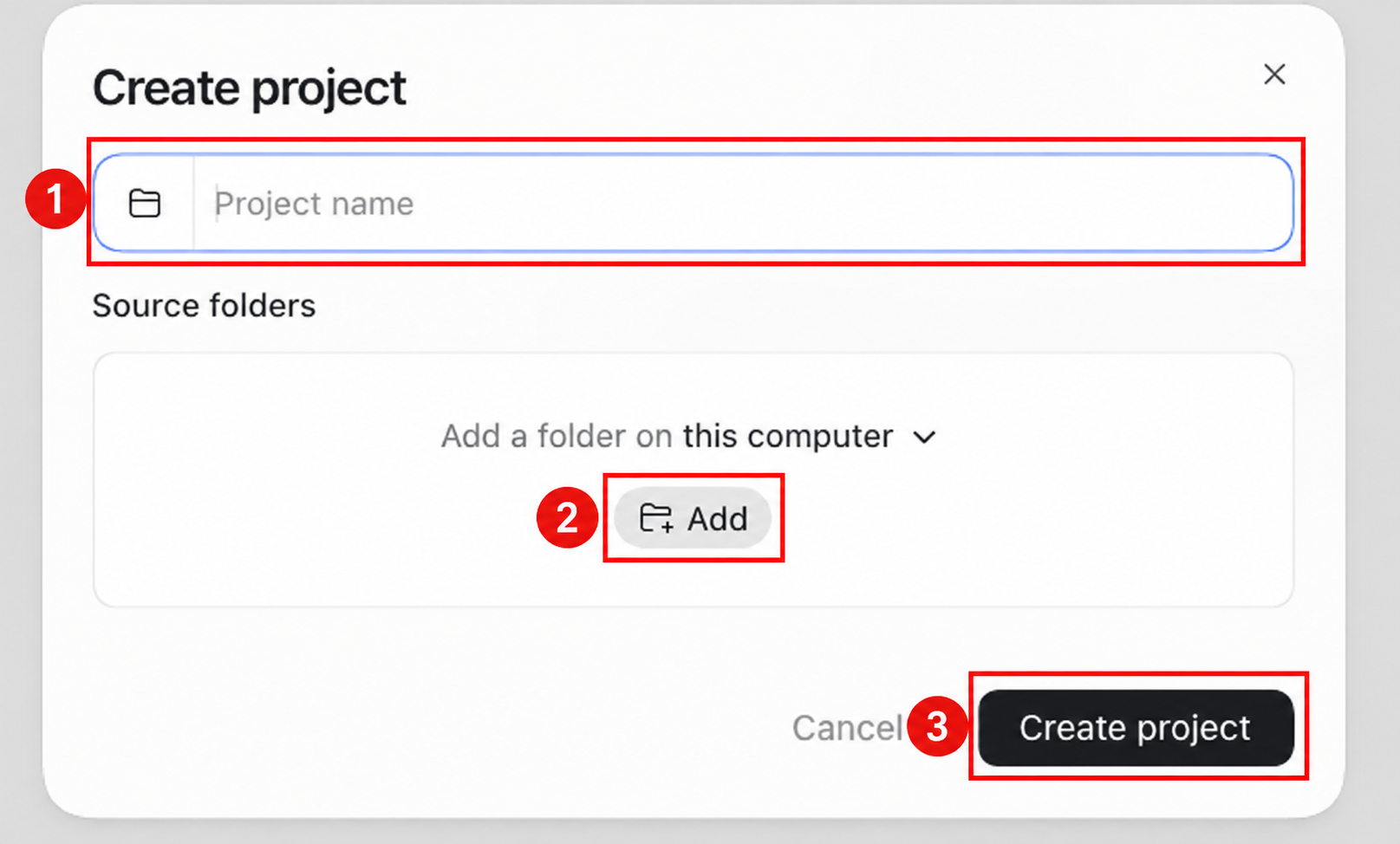
Pick the thing you need today.
- Copy a prompt and replace the parts in [brackets].
- Open a new chat at claude.ai or in the Claude app, then paste it.
- Answer any questions. Try the follow-up if the first result needs work.
Start with one task. You can come back for the others.
Get all 9 as a text fileThese are text-chat exercises. You can start on Claude’s free plan; usage and conversation limits apply. No connected accounts or scheduled tasks are needed.
1. Write the email you keep putting off
Paste the message you need to answer, with names and private details removed if they are not needed.
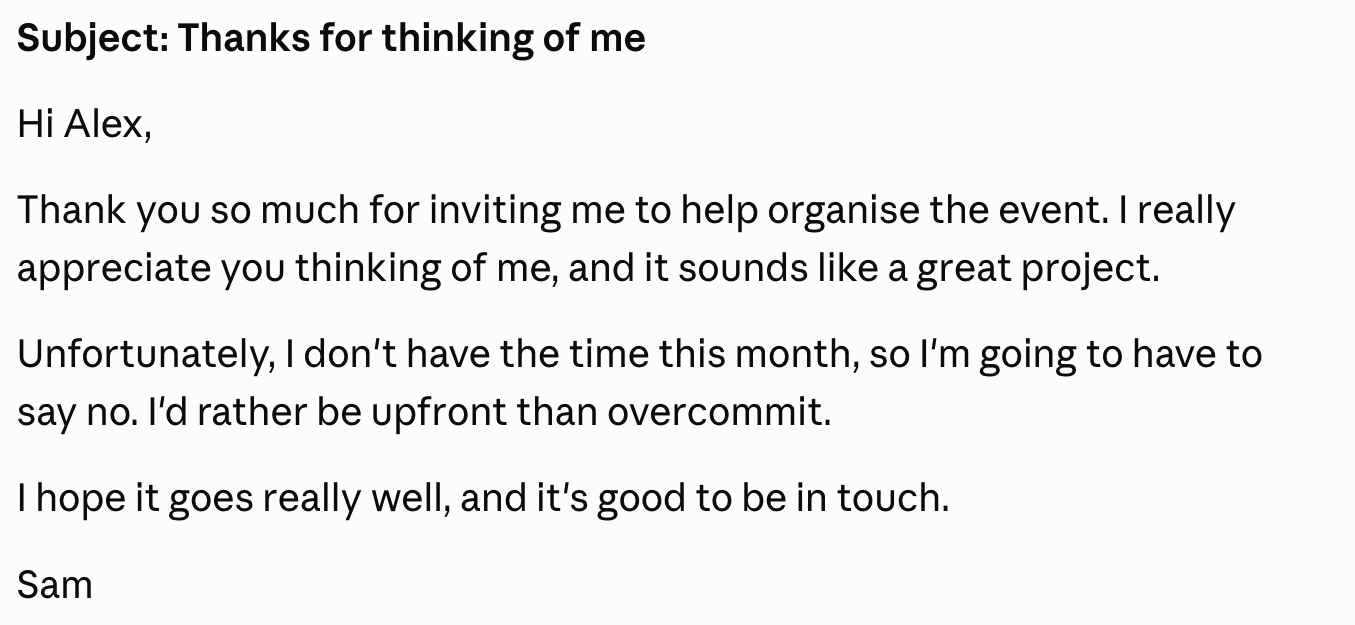
See a demo result
A warm reply declining a former colleague’s invitation to help with an event, without offering more work.
Copy this prompt
Help me write a difficult email that is clear, respectful, and sounds like me.

Situation: [what happened]
Recipient and our relationship: [who they are]
The outcome I want: [one specific next step]
Facts that must stay accurate: [dates, amounts, promises already made]
My boundary: [what I cannot agree to]
Tone: [friendly / neutral / firm]
Original message, if useful: [paste]

Ask up to 3 questions if a missing detail would change the meaning. Otherwise, draft a subject line and an email under 150 words. Make the request easy to find. Do not invent excuses, deadlines, agreements, or apologies on my behalf. Use brackets for facts I need to fill in.

Then give me a shorter version and one firmer alternative to the key sentence. Point out any wording that might accidentally make a commitment I did not intend.
Then try this
Make it warmer without weakening my boundary. Cut any sentence that does not help the recipient respond.Before you use the result: Check every fact and commitment before sending. Claude drafts the email; you decide what to send.
2. Rehearse your next job interview
Use a real job description and your actual experience. A short list is enough.
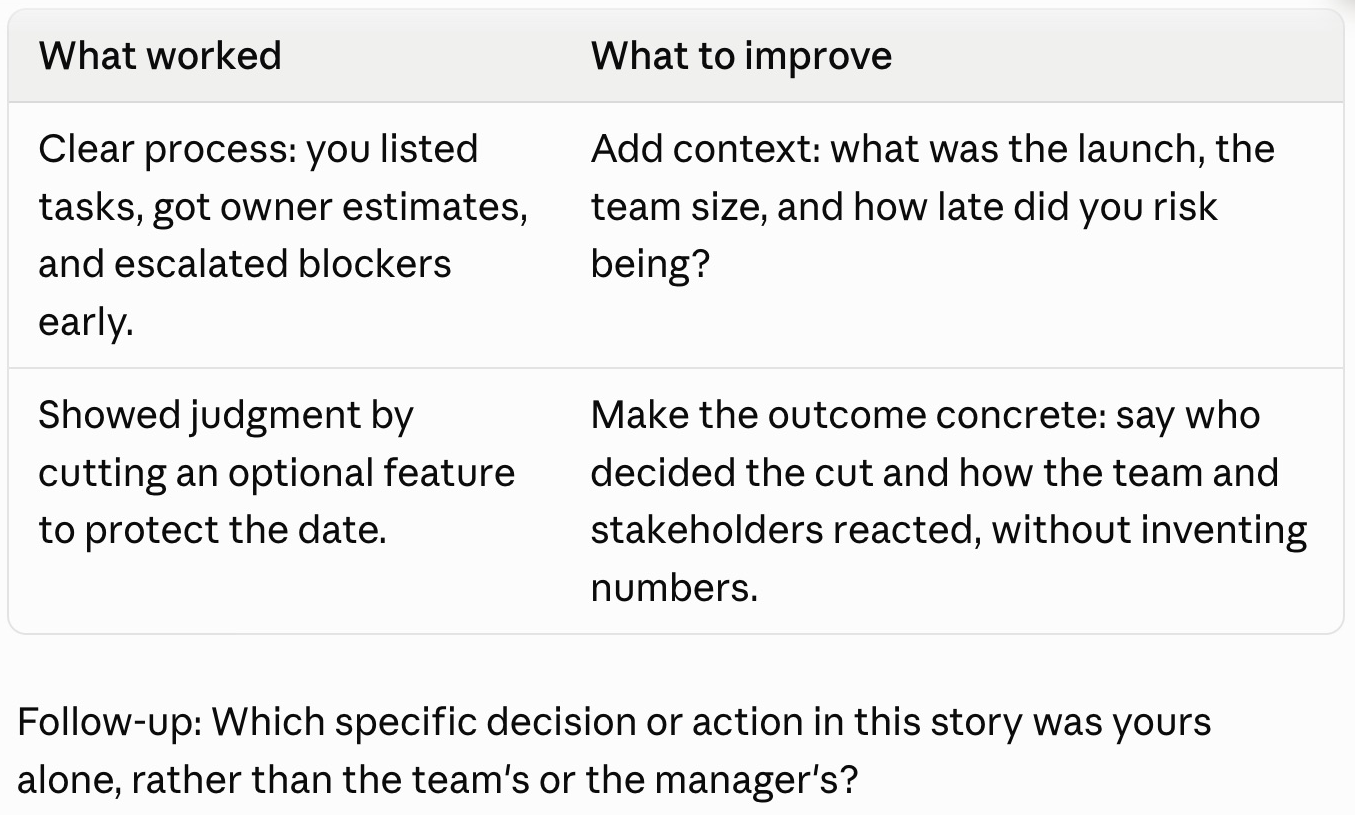
See a demo result
Feedback on a fictional project coordinator’s answer about a difficult deadline.
Copy this prompt
Run a practice interview for this role.

Job description: [paste]
My experience: [paste a CV or list relevant work]
Interview stage: [first call / hiring manager / technical / unknown]
Time available: [minutes]
What I find difficult: [example]

Ask one question at a time and wait for my answer. Choose questions from the job description, but do not claim these are the employer's actual questions.

After each answer, tell me: what was clear, what was vague, and one way to make it stronger. Ask a follow-up when I give a general answer without explaining my own contribution. Help me structure my real experience; never invent achievements, figures, or responsibilities.

At the end, identify 3 things to practise and suggest 3 useful questions I could ask the interviewer. Begin with the first question, not a list of tips.
Then try this
Ask that again with a tougher follow-up. Let me try a better answer before you show an example.Before you use the result: Keep the examples truthful. This is practice, not a prediction of the interview or a hiring guarantee.
3. Practise a real conversation in another language
Choose one situation you actually expect to encounter: a café, a work call, or a conversation with a neighbour.
See a demo result
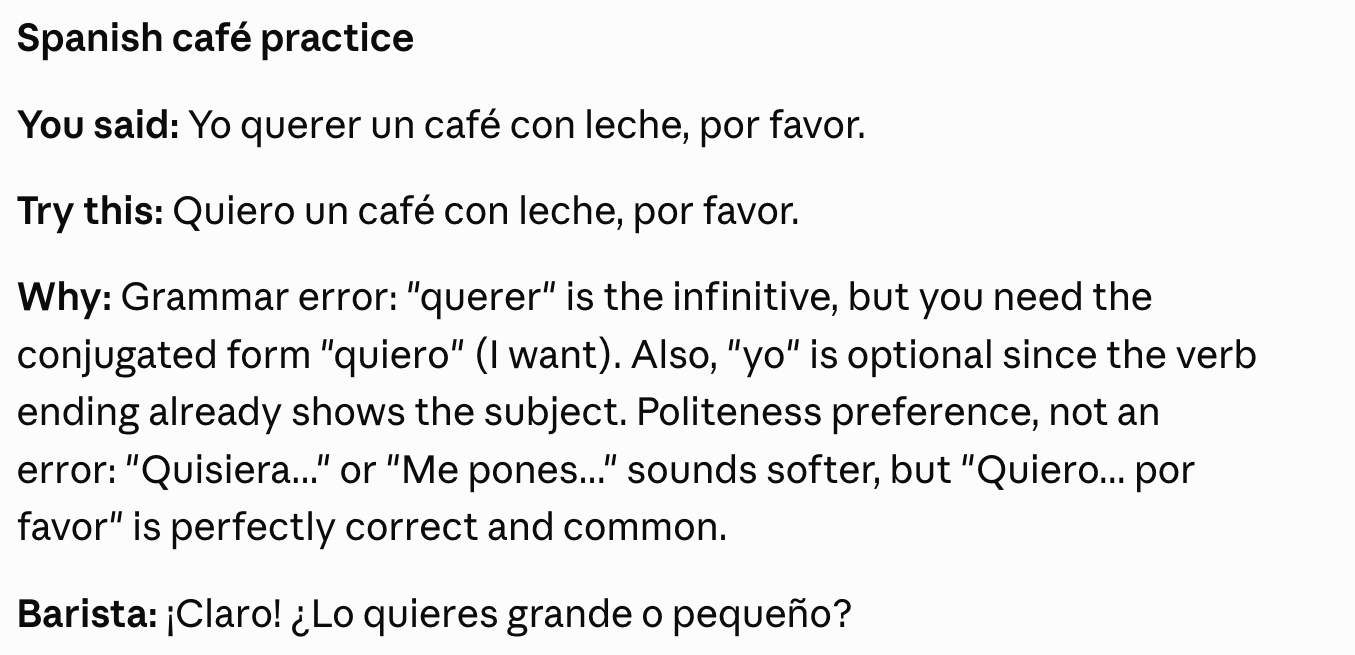
A Spanish café roleplay: correcting “Yo querer…” and continuing the conversation.
Copy this prompt
Help me rehearse a conversation in [language].

My level: [beginner / intermediate / advanced]
Situation: [specific real-life situation]
Who you are playing: [barista / colleague / neighbour]
What I need to accomplish: [goal]
Explain corrections in: [language]
Time available: [minutes]

Start the scene with one short line in the target language, then wait for my reply. Keep the conversation at my level. After I answer, correct at most one important mistake and give one natural alternative before continuing the scene. Distinguish an actual error from a phrase that is correct but less natural or less polite.

If I get stuck, offer a small hint before the full answer. At the end, list 5 useful expressions from our conversation and have me try the 2 I struggled with again. Do not give me the full dialogue in advance.
Then try this
Repeat the scene with a small unexpected problem so I have to use the phrases myself.Before you use the result: Use text chat for the basic exercise. Accent and pronunciation need audio feedback; a text reply cannot assess them.
4. Work out what to cook with what you have
List ingredients and approximate quantities. Include allergies and foods you avoid.
See a demo result
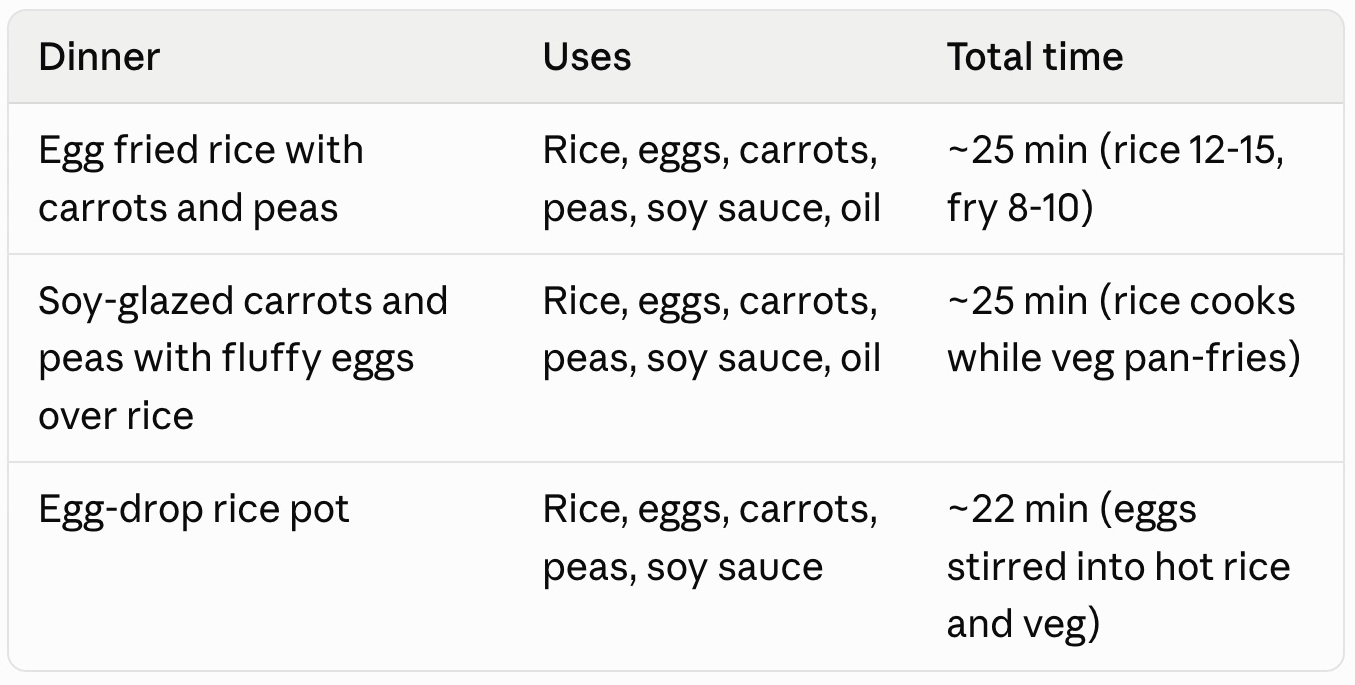
Three dinner ideas for two people using rice, eggs, carrots, peas, and listed cupboard ingredients.
Copy this prompt
Help me choose dinner using ingredients I already have.

Ingredients and approximate quantities: [list]
Number of people: [number]
Time available: [minutes]
Equipment: [hob / oven / microwave / other]
Allergies and foods to avoid: [list, or none]
Extra shopping allowed: [none / up to a specified amount]

Suggest 3 different dinners. For each, show which ingredients it uses, what is missing, and the estimated active and total cooking time. Do not assume I have oil, spices, or other staples unless I listed them; mark optional additions clearly. Respect the allergies and avoid suggesting food I have said is unsuitable.

Ask me to choose one, then give quantities and numbered steps for that dinner. If an ingredient's condition or safe preparation matters, ask rather than assuming it is safe. This is meal inspiration, not a medical nutrition plan.
Then try this
I choose option [number]. Simplify it to use fewer pans and explain what can be prepared first.Before you use the result: Check ingredient labels, allergies, freshness, and safe cooking guidance yourself. Times are estimates.
5. Compare a purchase without drowning in specs
Paste the specs or product descriptions for 2–4 options. Live prices are optional; the comparison can use only your supplied material.
See a demo result
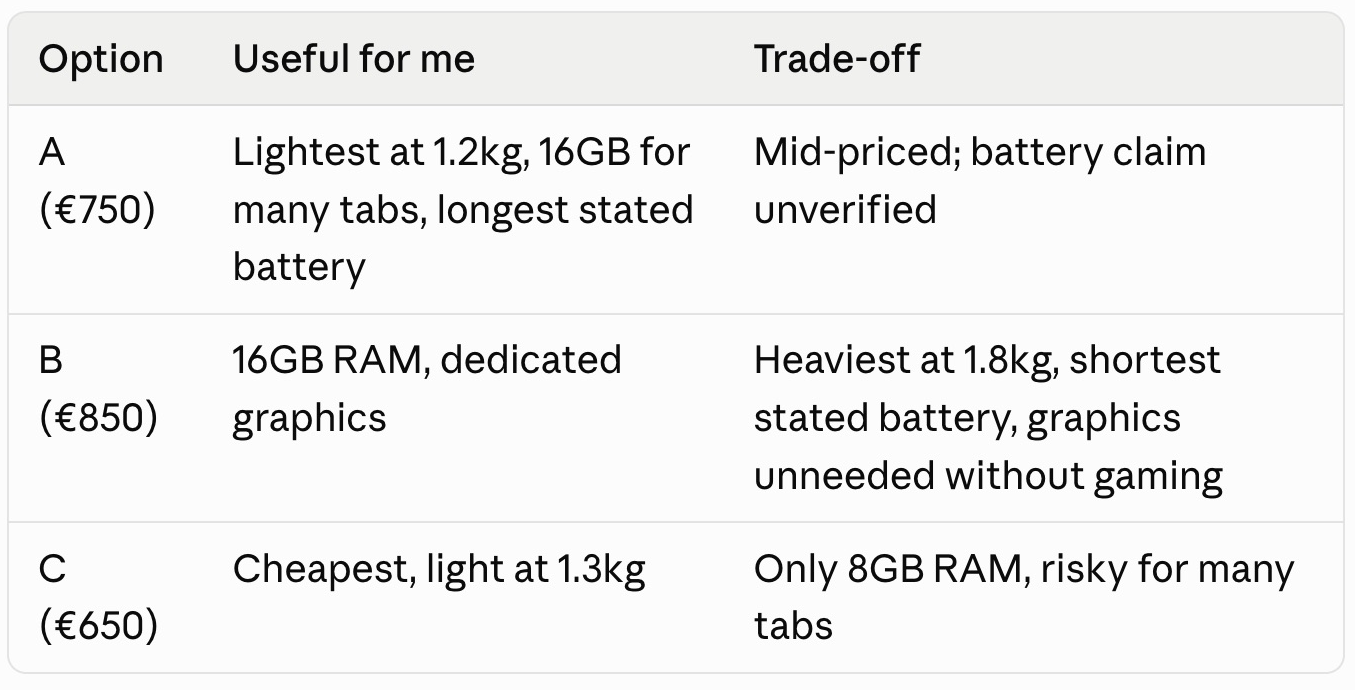
Three fictional laptops compared for commuting, document work, and lots of browser tabs.
Copy this prompt
Help me compare these options for my actual needs.

What I am buying: [item]
Options and their specifications: [paste]
My budget and currency: [amount]
How I will use it: [3 real situations]
Must-haves: [list]
Things I do not care about: [list]

First identify the 4 or 5 criteria that matter most for my use. Compare the options in a compact table using only the information I supplied. Mark missing information as unknown. Do not turn missing data into a negative score or invent specifications.

Recommend the best fit provisionally, explain its main compromise, and tell me what new information would change your recommendation. Include a cheaper-enough option if the extra features do not help my use case.

If I ask for live research and web search is available, check current local prices and specifications with links. Otherwise, tell me exactly what to verify before buying.
Then try this
Which feature am I most likely to overpay for? Explain using the way I said I would use this.Before you use the result: Confirm current prices, availability, specifications, and return terms with the seller.
6. Make a weekly plan that fits your actual time
List tasks, fixed commitments, and available hours. Include the small admin work that usually gets forgotten.
See a demo result
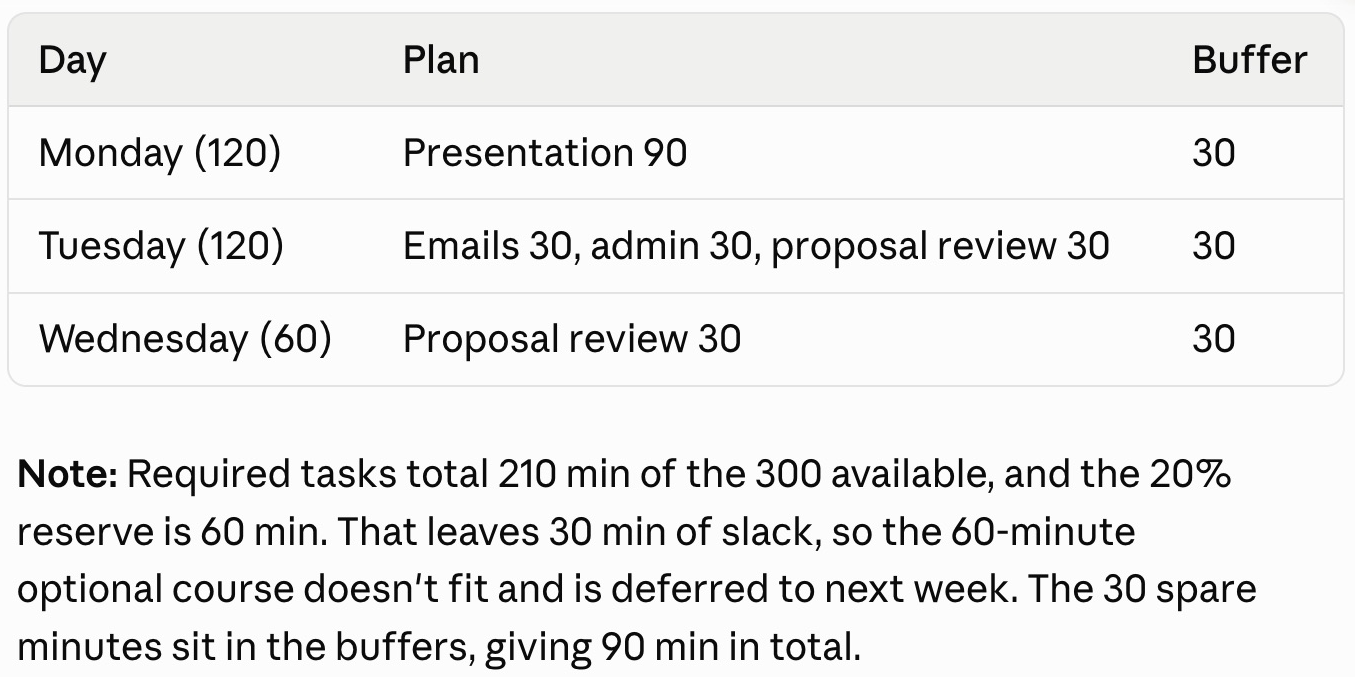
Five hours available across three days, with essential tasks scheduled and optional work deferred.
Copy this prompt
Help me build a realistic plan for this week.

Tasks, rough duration, and deadlines: [list]
Fixed commitments: [list]
Available work time each day: [hours]
My 3 priorities: [list]
When I have the most energy: [time of day]

Check whether the tasks fit before making a schedule. Show the total estimated task time and the time available. Leave about 20% of the available time unscheduled for delays. If the work does not fit, show the gap and ask me what to defer, reduce, or renegotiate. Do not silently move hard deadlines or schedule overlapping tasks.

Then give me a day-by-day plan with a clear first action for each priority. Separate essential tasks from optional ones. Label your time estimates so I can correct them. End with a small fallback plan for a day when I have half the expected time.
Then try this
[Task] took longer than expected. Replan the remaining days while keeping the fixed commitments and showing what no longer fits.Before you use the result: This creates a plan in chat. It does not add calendar events, set reminders, or check in on its own.
7. Get help with a spreadsheet formula
Paste 3–5 anonymised rows, your column names, and one example of the correct result.
See a demo result
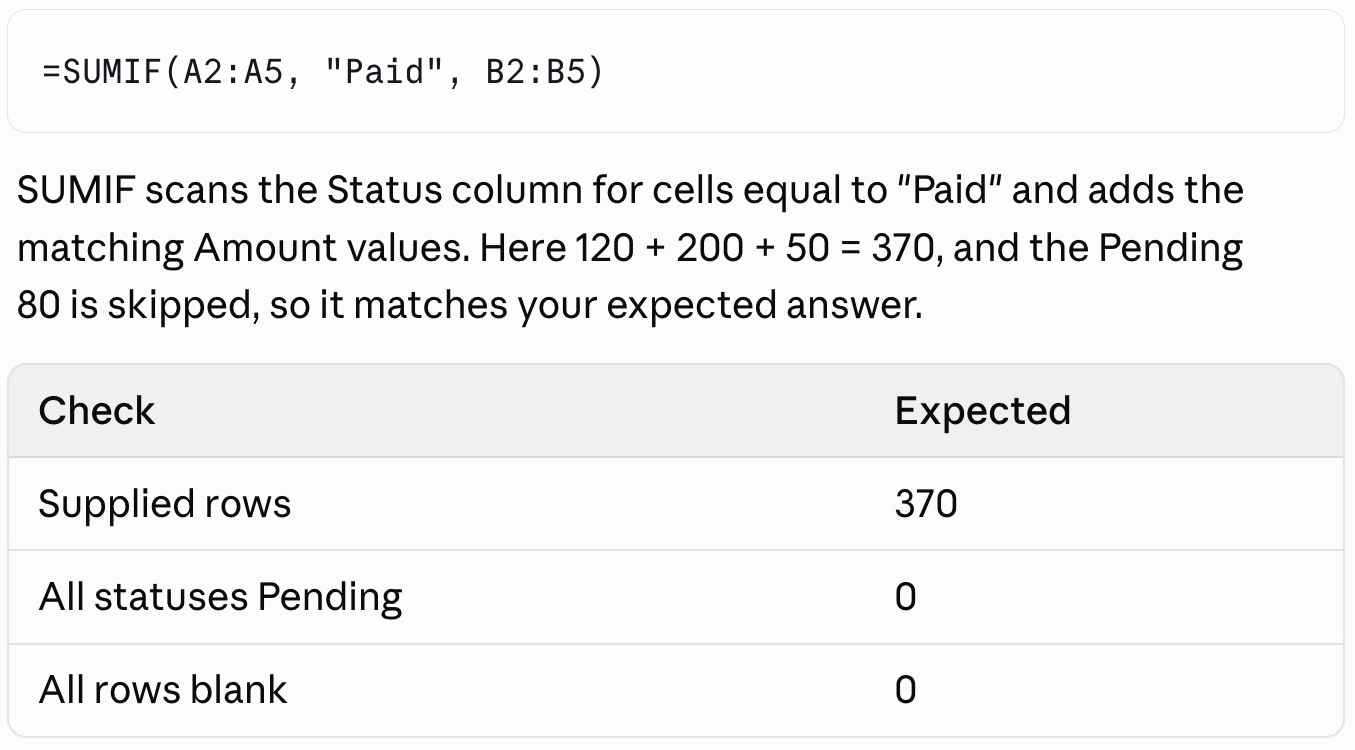
A SUMIF formula that adds only paid invoices: 120 + 200 + 50 = 370.
Copy this prompt
Help me write and check a spreadsheet formula.

App: [Excel / Google Sheets]
Language and locale: [language/country, if known]
Column names and sample rows: [paste]
What I want to calculate, in plain words: [task]
One input and the output I expect: [example]
Where the formula should go: [cell]

If you need a missing column, range, or rule, ask before writing the formula. Use functions supported by my app and explain any locale-dependent names or separators. Give me the formula, where to paste it, and a short explanation of how it works.

Check it against my example. Then show 3 small test cases, including a blank cell and a case with no match, with the expected results. Warn me if text-formatted numbers, dates, or inconsistent labels would change the result. Prefer the simplest formula that solves the task.
Then try this
I get this error: [paste]. Here is the exact formula and a sample row. Diagnose the cause before proposing a replacement.Before you use the result: Test on a copy of the sheet and verify the sample results. The card shows English function names with comma separators.
8. Turn your notes into a useful self-test
Paste notes from a lesson, article, or book section you are allowed to use.
See a demo result
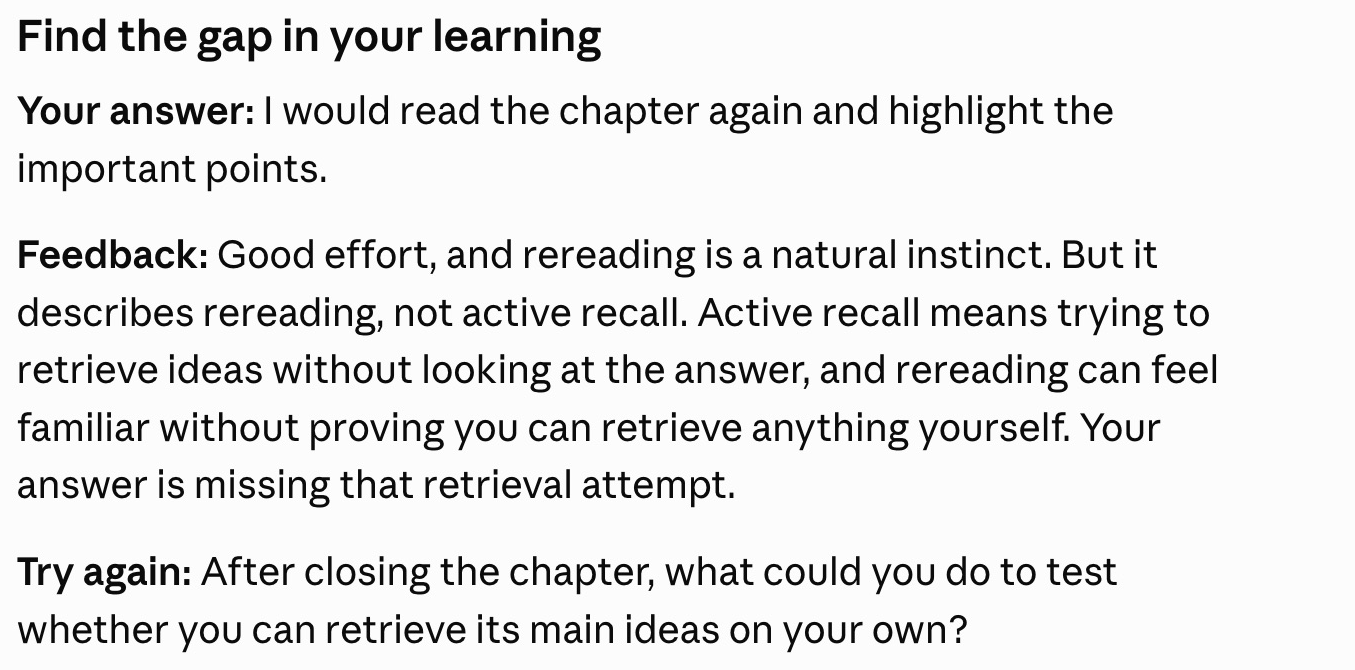
Feedback on a practice answer that confuses rereading with active recall.
Copy this prompt
Help me check whether I understand these notes.

Notes: [paste]
What I need to use this knowledge for: [goal]
My level: [level]
Time available: [minutes]

Base the exercise on the notes I provide. If they are incomplete or contradictory, point that out rather than quietly filling the gaps with invented details. Clearly separate any additional background you introduce.

Ask me one question at a time and wait for my answer. Mix recall, explanation in my own words, and application to a small example. Do not show the answer before I try. After each response, tell me what is correct, what is missing, and where in my notes I should look again.

After 5 questions, give me a short list of what to revisit and one final question about the weakest area. If the notes are too short for 5 useful questions, say so.
Then try this
Test the same ideas with new examples. Avoid repeating the wording of the earlier questions.Before you use the result: Check important claims against the original material. A fluent answer is not proof that the source notes are correct.
9. Turn a messy thought into a post that sounds like you
Paste your rough notes and 1–2 examples of your own writing. A typed ramble is enough.
See a demo result
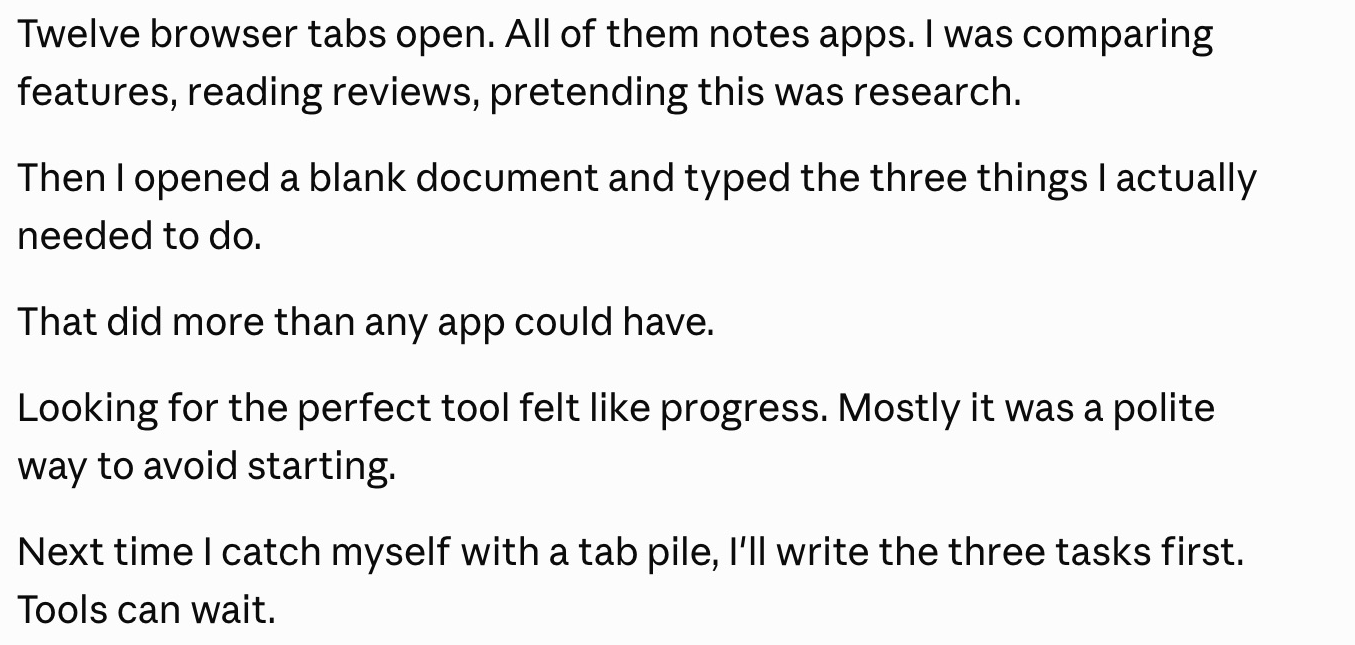
A fictional author’s rough notes about choosing a notes app, turned into a short social post.
Copy this prompt
Help me turn these rough notes into a clear social post while keeping my voice.

Notes: [paste]
Platform: [platform]
Who I am talking to: [audience]
The one thing I want them to take away: [point, or help me find it]
Examples of my writing: [paste]
Maximum length: [words or characters]

First tell me the clearest central idea you see. Ask up to 3 questions if the story or conclusion is missing. Then write one draft with a concrete opening, one main idea, and a useful takeaway. Keep natural phrases from my notes.

Do not invent personal experiences, results, quotes, statistics, or authority. Mark any factual claim that needs checking. Avoid motivational filler, inflated promises, and generic AI language.

Finish with 2 alternative opening lines and a brief note explaining what you removed or rearranged. Do not add a sales pitch or a call to action unless I requested one.
Then try this
This sounds too polished. Bring back more of my original wording and remove anything I would not say out loud.Before you use the result: Read it aloud, check factual claims, and keep only the parts you actually stand behind.
Give it something real to work with.
A useful prompt includes your situation, your constraints, and what a good result looks like. If the answer misses the point, tell Claude exactly what it got wrong and ask it to revise.
The demo screenshots were captured in Claude Desktop on 5 October 2026 using Sonnet 5.5 Medium on a Pro account. They show short demo variants, including simulated practice exchanges, rather than every full prompt and follow-up above. Your results will vary. Independent guide by Sam Cherkasov; not affiliated with Anthropic.